Saturday, September 30, 2017

Some of My Favorite Topics within Labor Economics

I hadn't really thought about the fact that Larry Katz has been involved in so many of my very favorite literatures....until reading this interview. A big take-away:

Region: Thank you. I’ve learned so much today, and we’ve touched just a fraction of your work. I don’t know where you find the time to produce so much!
Katz: One thing is trying to leverage teams in research, which is a big trend in economics, a healthy trend. Most projects are not just done on your own; they involve a team of scholars working with large data sets, setting up the field experiment, collaborating with others.

Sunday, September 24, 2017

Unanticipated Cool Part of the Job..

Having journalists write about your research in a way that makes it sound even more exciting than you thought it was!

Read this.

And then this.

I told you writing is important!

PS
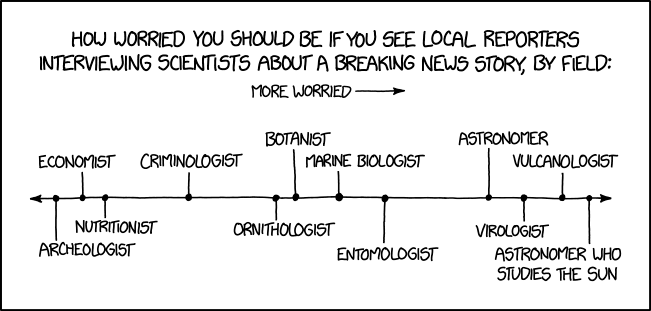
From xkcd.com

Worrying Scientist Interviews

https://xkcd.com/1895/

Friday, September 15, 2017

Friday, September 8, 2017

More Advice on How to Write

David Eli has some advice. All good advice. But now my advice which I guess is a shortened version of what he says: 1. Pay attention to good (and bad) writing when reading it. 2. Write. 3. Rewrite. 4. Rewrite again.

Are you still reading this? Get back to your writing!

Sunday, August 6, 2017

Even Smaller P-Values?

Have you ever had a brilliant idea for a paper---one with an interesting and important question and a believable identification strategy? After a lot of work, you acquire and manage to clean up the perfect data set. You run that regression. Maybe you even get the expected sign and a reasonable estimate of a coefficient.....but the standard errors are just too big. You run a few more regressions and no matter what you try, you just can't get that p-value below .05 and so you end up putting that project in the filing cabinet. There just isn't enough variation in the data to identify anything. <sigh>

Well, it seems like this actually isn't happening as often as it should. Too many papers are being published that cannot be reproduced. Daniel Benjamin, a behavioral economist at USC, and 71 coauthors from a variety of fields have just published a paper with this one sentence summary: 

We propose to change the default P-value threshold for statistical significance for claims of new discoveries from 0.05 to 0.005.

This would certainly require larger sample sizes if we wanted to keep publishing the same number of papers with "significant" results. My personal view: To start, why not do away with the norm of reporting just standard errors with the little stars? Why not instead publish p values? That way readers could easily and quickly distinguish between a p-value of .049 and .0049.  I wonder if this would a make a difference in terms of which papers get published in the different journals. 

And now, because I have no shame, I will share the song that I can't get out of my head as I am writing about p's. Have a listen to this and share with your kids.  :)  

(h/t David McKenzie, again)

Sunday, July 30, 2017

"Relax. Nothing is Under Control."--Adi Da

That quote seems particularly fitting for my life right now, but since this is a blog about doing applied micro, let me write again about control variables (hehe, I know corny). Marc Bellman has a new blog post about the sensitivity of results to the use of particular controls. On the one hand, we should expect results to be sensitive. That's why we include those controls! On the other hand, if researchers are playing with different specifications including many different combinations of controls and only reporting those generating significant results, ...well, you know. 

Marc's post discusses a recent working paper by Lenz and San showing that in about 40% of the observational studies analyzed in the journal, American Journal of Political Science, researchers obtain statistical significance of their estimate of interest by tinkering with the covariates included. 

Yikes! Would you expect similar numbers in an economics journal? 

In past blog entries, I've written about how economics papers have gotten longer and longer over the years and how referees often help write the paper instead of just 'refereeing'. But now that I see that 40% figure, I think maybe these are not such horrible developments. If you have only one specification to tinker with, it's not so hard to get that statistical significance, but if you have many suggested by referees, it's not impossible but certainly a lot harder. 

Economists have been worried about the issue of control variables recently. I really like Marc's description of two recent papers:

(1) y = a + bX + cD + e
"The issue of what goes on the RHS of equation (1) is getting a lot of attention in the applied literature. Two prominent examples are Emily Oster’s forthcoming JBES article “Unobserved Selection and Coefficient Stability: Theory and Evidence” and Pei, Pischke, and Schwandt’s (2017) NBER working paper titled “Poorly Measured Confounders are More Useful on the Left than on the Right.”

Oster provides a method to assess just how much coefficient (as in coefficient c in equation 1) stability tells us about selection on unobservables. Pei et al. develop a test of identifying assumptions that treats putative additional controls as dependent variables in equation (1).
I expect both methods to become part of the applied econometrician’s toolkit over the next five to 10 years. At the very least, I expect a bare-bone regression of y on D alone to become something that has to be included in a paper, along with a discussion of why the controls that were included on the RHS of equation (1) were retained for analysis."