Wednesday, October 15, 2025

Cool Data Alert: Voting Rights for Immigrants Across Countries (and Even More Locally) and Time

The GLOBALCIT Dataset of Migrant Electoral Rights (MER) covers voting and candidacy rights for both non-citizen residents and non-resident citizens. The dataset contains up to 488 indicators of voting rights across 165 countries from 1960 to 2020! 


More details (including the codebook and the actual data) here

Sunday, September 14, 2025

How to Write an Economics Paper--Smart Tips from my Smart Colleague

My most senior colleague has written some tips on how to write a research paper in economics. UConn third year paper writers, please take careful notes! Thank you, Subhash Ray, for putting this together. 

Click on the link

Friday, April 25, 2025

Four (Not Three?) Steps to Writing an Applied Microeconomics Paper

Students in my PhD Labor course are writing papers this week. I was going to send them this for guidance but then decided I'd share it with all of you. Thank you, Jesse Shapiro for putting it together. 

Confession: I'm not sure I've ever written an aspirational introduction, but I do often write aspirational abstracts. 

And lastly---it's not often you see a four step process for anything. Two steps, sure. Three steps, absolutely. You rarely see four. No wonder writing papers is so tricky! 

Wednesday, April 23, 2025

How to Choose a PhD Program

The April 15th deadline has come and gone, and so this post is a bit too late for this year's cohort. Nevertheless, I am putting a link to this JPAL article here with the hope that it will be useful for next year. 

For those of you reading this with multiple offers in hand, let me first say, "Congratulations!" I know this is a stressful time, but it really is great news that multiple departments are hopeful about your promise as a future researcher. Let me also plead with you: If you are in this situation, do research the different departments as much as you can before making a decision. However, as you narrow down your decision, please decline offers as soon as possible. Please do not wait for the evening of April 15th to decline offers. 

Congratulations to all of you who have recently accepted offers! We are very excited to meet you! Good luck to all of you who are now starting the process of thinking about where to apply next year. 

Friday, March 21, 2025

Thursday, February 13, 2025

Cool Data Alert: Cross-Gender Social Ties

 Ever wish you could measure cross-gender social ties? Do you have a hypothesis about friendships that you would love to test with data. 

Good news: Data from the paper, "Cross-Gender Social Ties Around the World" (by Mike Bailey, Drew Johnston, Theresa Kuchler, Ayush Kumar, and Johannes Stroebel) is now publicly available

Look at that beautiful variation! 


Thursday, July 18, 2024

Need Inspiration for a Paper Topic?

Do you need to write a paper for a field course? Are second/third year paper deadlines quickly approaching and every time you think of an interesting question, the necessary data does not exist or there is no exogenous variation or.. We have all been there. My suggestion: Have a peek through this website which compiles information on plausibly exogenous sources of variation. It seems a bit backward, but you may be able to link a right hand side variable from the website with an outcome that you're particularly excited about. Good luck! 

H/T: Treena Goswami 

Sunday, June 23, 2024

How to Conference

See this excellent thread with tips on how to conference (thank you, Ben Harrell!). You can think of that as the gold standard for conferencing. You don't have to do it all of it, at least not all of the time. Resting is also important. 

But I can tell you what not to do: Spend the entire time in your hotel room fixing your slides (or writing your discussion) and not participating in the conference at all. A conference is--or at least can be---so much more than your talks. And I'd say try to have fun if you can. Conference travel is one of the big perks of our job. Enjoy them! 

Friday, June 21, 2024

Pedro Sant’Anna’s Difference-in-Differences Checklist


Pedro provided the checklist. Scott Cunningham shows us how to go through the checklist, step by step, with Stata code! These guys sure do make it easier for us to do the right thing. Here Scott shows us Step 1. And here is Step 2. Oh, and there's Step 3, too! 

And just this morning, Step 4

Monday, June 17, 2024

Cool Data Alert: National Study of Caregiving (NSOC) and More

Here is the information. 

UConn PhD students (and honors students writing theses, etc.)---if you want to work with these data, I'd be interested in serving as your advisor. 

To prospective PhD students--if you want to work with these data, consider applying to the UConn PhD program. I'd love to work with you. 

And I just found more interesting data sets on these issues: 

National Long Term Care Survey (NLTCS)National Long Term Care Survey (NLTCS)

which can be linked with CMS data can be linked with CMS data


Saturday, May 18, 2024

An Introduction to Event Studies

I thought I had a solid understanding of event studies, sure. But then when you go out to actually do one for a not completely straightforward case (e.g., What if the intensity of "the event" varies? What if there are multiple events per unit?). Have a look at this Journal of Economic Perspectives piece, "An Introductory Guide to Event Study Models," written by Doug Miller. 


H/T David Simon. It's good to have colleagues who know a thing or two about this sort of thing! 

Friday, February 16, 2024

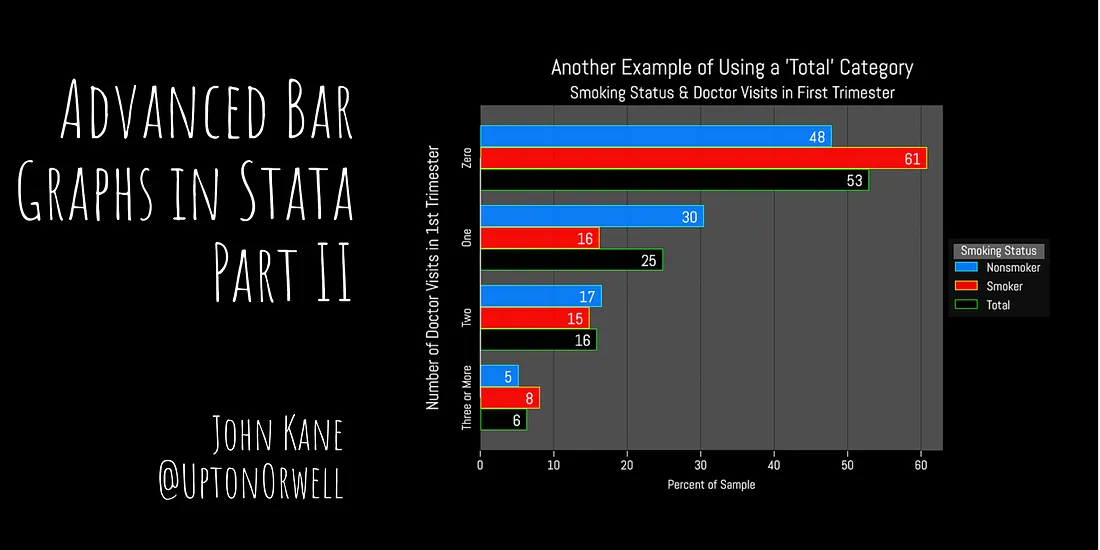
How to Make Nice Bar Graphs in Stata

Sure, you can just show a table, but nobody will remember that or pay much attention to start. Much better to tell your story with a picture. 

Here are some helpful tips on how: Part 1 and Part 2. Thank you, John Kane for putting this together and to David Mackenzie for finding it. 


Friday, February 9, 2024

To Post-Doc or not to Post-Doc. Is That the Question?

David McKenzie provides useful advice not only on whether or not to do a post-doc but also best practices if you do decide to do one.  

My thoughts: Post-docs vary a lot! Some are really just high-skilled RA positions--which is not necessarily bad if you're learning a lot. Others just give you a lot of free time to pursue your own work--which is not necessarily great if you don't have a clear direction for future projects. My point: There is no clear answer to the question of whether it is good or bad to do a post-doc. It really depends on the particular post-doc position you are considering and the non-post-doc position you are giving up or postponing. 

Good luck, JMCs! 

Tuesday, January 16, 2024

Potentially My Most Useful Post of the Year? Decade?: AI for Economists, Prompts and Resources

We hear a lot about the dangers of AI (and these are real!), but we do not hear enough about how useful LLMs can be. Check out these prompts and other resources for use with LLMs made available by Jesse Lastunen. And do share in the comments if you discover any additional useful prompts. 


H/T: Marginal Revolution 

Friday, January 5, 2024

Cool Data Alert: Child Penalties Across Countries

The website describes it like this: "The Child Penalty Atlas maps how the arrival of a child affects the careers of men and women across the globe." I recommend playing with the map a bit. You can see for most countries in the world, the child penalty in employment, the gender gap in employment, and the fraction of the gender employment gap explained by the child penalty.

How many new papers idea using these data can you come up with? 1-2-3, go! (UConn students, feel free to come discuss your ideas with me). 

Here is the website: https://childpenaltyatlas.org/. 

Wednesday, August 2, 2023

Cool Data Alert: Aging

At this summer's NBER SI Aging, Kosali Simon introduced new data from all over the world that can be used to study the economics of aging. She just posted her slides online

Thank you, Kosali. UConn PhD students, start exploring and let me know if anything inspires you. 

Sunday, July 16, 2023

How to be a Good Discussant

Your third year paper was accepted for presentation at a conference. Congratulations! But now you've been asked to discuss someone else's paper at that conference. What should you say during those 5-10 minutes? Every single thought you have on the paper? NO!!! 

See Chris Blattman's The Discussant's Art, an oldie but goodie. 

The most important thing to keep in mind: Your discussion is mostly for the conference participants, not the authors. You want to help the audience better understand and appreciate the presentation they heard. Speak to them! 

Of course, you've read the paper and have lots of ideas. Absolutely share these ideas with the author! They can be very valuable and appreciated, even the "you have a typo on p. 18"-type comments. But do this one-on-one with the author. Ideally, meet for coffee during the conference. Otherwise, send the detailed comments over email after the conference. 

But the discussion is mostly for the audience. Keep it short but profound. :) 

---

Chris Blattman's Tips Copy-Pasted here for convenience: 

1. Start by telling people why they should care. It is seldom obvious. What’s the big question, and what’s at stake if the paper gets it right or wrong?

2. Then summarize the paper. Break it down differently than the presenter. Pretend you are explaining it to your grandmother. Or, rather, your adult-attention-deficit-disorder grandmother. Keep it short.

3. Say more with less. Mathematically, everything you say after your best point lowers the average quality of your comment. Pick your three best points, say them briefly, then stop talking.

4. Now, say even less. Those three comments? Write out, in bullets, exactly what you plan to say. Now cross out half. What you think will take eight minutes will take fifteen. Bring it back to eight.

5. Be constructive. A colleague once said to me: “I like it when people find problems with my paper, but I like solutions more.” Finding solutions makes you think (and displays it too).

6. Don’t discuss the small stuff. Write your little comments down, and later give them to the author. Don’t bore the audience with footnotes and trivia.

7. Feel free to entertain. A discussant need not merely list ideas. You can weave in an anecdote, or frame a point with a story. At least speak from a personal point of view, not a monotone benevolent overlord.

8. Have fun, don’t make fun. If you use humor, let it not be at the expense of anyone but yourself.

9. Spell it out for us. Tell us why your comments matter. Say precisely what we learn.

10. Aim for profound. The best discussants rotate my brain 90 degrees. They reframe the problem, or propose a novel idea. I can’t tell you how to be deep. I seldom succeed myself. For me, a few things usually help. I read the paper, walk away for a day or two, then return. I ask myself questions: Do I think about a big question differently now? What convinces me, and what would convince me more? Where should the field be going?

More on Shift-Share Instruments via Borusyak, Hull and Jaravel

It is tricky to keep up with the econometrics literature on shift-share instruments. But it's important. Here is a review paper written by Borusyak, Hull and Jaravel. 

David McKenzie highlights the following: “Identification in the general case, for arbitrary formulas and designs, follows from simple adjustments based on the expected instrument: the average value of the formula across counterfactual sets of shocks, drawn from the specified assignment process. Specifically, OVB is avoided by either adding the expected instrument as a control or by using a recentered instrument which subtracts the expected instrument from the original formula. Controlling for or recentering by the expected instrument is generally necessary for identification with formula instruments, absent auxiliary assumptions on the exogeneity of shock exposure.”

Thursday, May 18, 2023

Cool Data Alert: Immigration Policies Related to Low-Education Immigrants in 31 Countries, 1783-2010

Here is the data. And the official description: 

Immigration policy for low-skill immigrants, 1783-2010, for the following countries: Argentina, Australia, Brazil, Canada, France, Germany, Hong Kong, Japan, Kuwait, the Netherlands, New Zealand, Saudi Arabia, Singapore, South Africa, South Korea, Switzerland, Taiwan, United Kingdom, United States. 


Tuesday, October 5, 2021

Stata Tip: Creating Quick and Beautiful Tables of Descriptive Statistics with Asdoc

Open up Stata right now and write this in the command window: 

ssc install asdoc, replace

help asdoc

Upload your favorite data set and start making beautiful tables of descriptive statistics! It's like tabstat, but you will have no additional formatting to do. No need to copy-paste from the Stata window into excel. No need to spend hours making tables beautiful. Impress your coauthors and advisors with these beautiful tables even for just preliminary analyses! Read more here

You're welcome! 

I'll take the credit for discovering this, but thank you StataProfessor for making it.